


 EN
EN
 AR
AR
 BG
BG
 HR
HR
 CS
CS
 DA
DA
 NL
NL
 FI
FI
 FR
FR
 DE
DE
 EL
EL
 IT
IT
 JA
JA
 KO
KO
 NO
NO
 PL
PL
 PT
PT
 RO
RO
 RU
RU
 ES
ES
 SV
SV
 TL
TL
 ID
ID
 SR
SR
 SL
SL
 VI
VI
 SQ
SQ
 HU
HU
 TH
TH
 TR
TR
 MS
MS
 GA
GA
 MK
MK
 HY
HY
 AZ
AZ
 BN
BN
 MN
MN
 MY
MY
 KK
KK
 UZ
UZ
 JOZO GROUP
 JOZO GROUP
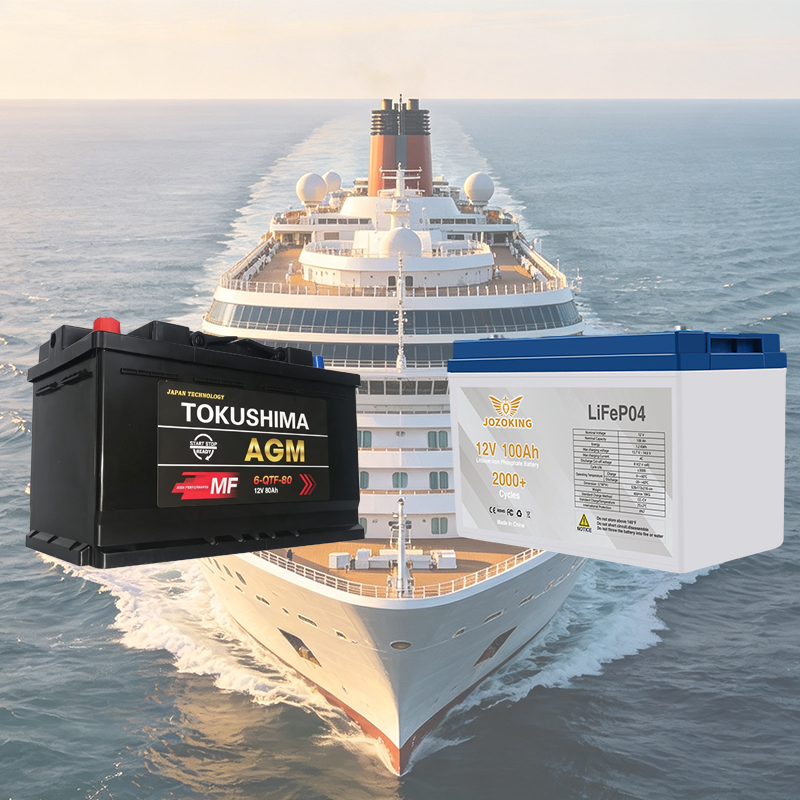
The maritime industry for decades, has exclusively relied on old lead acid battery technology for starting engine and providing electricity on boats, however the advent of modern technology with lithium-ion chemistry has been presented as an alternative with the capability to increase efficiency of your vessel and provides an even better long term value. At JOZOKING (TIANJIN) TECHNOLOGY CO., LTD. we produce quality Lead-acid battery solutions, and also lithium battery marine applications and we see the challenge for owners determining between the two types for house loads, to house load system.
Marine Starting Power: Cranking Performance and Reliability
Starting a marine engine demands a brief but intense burst of power, typically 75 to 400 amperes for 5 to 15 seconds. Traditional lead acid battery designs excel at this task because they feature thin, numerous plates that maximize surface area for rapid current delivery. These starting batteries are cost-effective, reliable, and readily available, with proven performance in demanding marine environments.
Increasingly however, lithium ion battery technology is making in-roads. Our lithium starting batteries, available in lithium 48 volt battery configurations such as the JOZOKING 80D26, boast outstanding Cold Cranking Amps (CCA) performance of 1,200CCA while only weighing a phenomenal 7.5kg – compared to over 20kg for a comparable lead-acid battery! That weight saving alone offers huge advantages in terms of vessel performance and fuel efficiency, while maintaining the high voltage needed for consistent, reliable starting.
The big concern is compatibility - Lithium batteries need their own charger and electrical management system to ensure the proper charging voltage . Vessels with outdated charging systems will need to upgrade the charger, and likely the alternator as well. This will affect the cost of the conversion.
Deep Cycle and House Power: Sustained Energy Delivery
The Deep Cycle Battery for all you needs. When you need power for lighting, onboard electronics, GPS systems, trolling motors and other applications you want to rely on deep cycle batteries and there is none better for the application than a deep cycle lithium battery compared to its lead-acid cousin. Deep Cycle marine battery energy storage system batteries need to have the capacity to recover from repeatedly deep cycling without sacrificing performance.
This is where lithium shines. You want to ensure a lead acid deep cycle battery is never discharged more than 50% of its capacity to prevent permanent damage. If your battery has a rated capacity of 100Ah, you only get 50Ah of usable power. A lithium battery marine system can be discharged to 80-90% capacity and nearly double that from a given battery capacity.
Similarly dramatic are the cycle life differences between lithium and lead acid deep cycle batteries, the latter provide 300-800 cycles while lithium provide 2,000-5,000 cycles. That means ten to fifteen years use from a lithium battery compared to three to five years of life from a lead acid. For liveaboards, offshore cruisers and commercial vessels with substantial loads, this cycle life dramatically reduces their overall ownership cost.
Cost-Benefit Analysis: Initial Investment vs. Lifetime Value
Cost is the biggest deterrent, High up front cost The initial and most significant deterrent is price, for the same size (100Ah-300Ah) lithium battery costs $800-$2,500, vs $200-$600 for lead acid battery. When done on a cost per cycle, that is where lithium excels.
| Battery Type | Initial Cost | Typical Cycle Life | Cost Per Cycle |
| Flooded Lead-Acid | $200 | 400 cycles | $0.50 |
| AGM Lead-Acid | $400 | 700 cycles | $0.57 |
| LiFePO4 Lithium | $900 | 4,000+ cycles | $0.23 |
In ten years a lithium system may result in total savings of $1,200 to $4,500 for a mid-sized boat. Additional savings can also be attributed to its significantly reduced weight (50-70% less) leading to increased fuel efficiency and a dramatic reduction in routine maintenance requirements, such as watering and cleaning of terminals. For example, for the commercial fishing fleet, the weight savings may alone result in a $12,000 saving in diesel over 10 years.
A techno-economic study on hybrid short-sea ships concluded lead acid batteries 80% depth of discharge resulted in a 17% cost reduction and 18.6% decrease in emissions under some operating conditions. However, lithium-ion batteries, at the present time, have a stronger economic case for applications with significant cycle count and high energy demand.
Choosing the Right Solution for Your Vessel
Whether to opt for a lead-acid versus lithium solution, then it really comes down to your boating requirements.
Choose lithium if you:
Are a frequent boater with high daily power demands
Operate a liveaboard or undertake multi-day voyages
Have sensitive electronics requiring stable voltage
Value weight reduction for performance or fuel economy
Plan to keep your vessel for 5+ years
Choose lead-acid if you:
Are a casual weekend boater with minimal power needs
Have a tight initial budget
Own an older vessel with incompatible charging systems
Prefer the proven simplicity of conventional technology
For boats needing both massive cranking power as well as large house load requirements JOZOKING offers both house-focused and starting battery configuration to ensure you select the right technology. Our TOKUSHIMA range covers marine cranking solutions in both automotive, trucks and heavy construction equipment applications. Contact us today for the right solution for your marine requirements.


