

Home > News > Company News
JOZOKING News | Sodium-Ion Battery Technology Innovation
As the global battery industry continues to evolve, sodium-ion batteries are emerging as an important alternative to conventional battery technologies. With abundant raw materials, promising low-temperature performance, and the potential for improved cost efficiency, sodium-ion technology is attracting increasing attention from battery manufacturers and automotive industries worldwide.
JOZOKING is pleased to announce that the company has successfully developed its own sodium-ion battery technology and has brought sodium-ion batteries into practical use. The product showcased this time is a 12V sodium-ion automotive starting battery, marking an important step in JOZOKING's battery technology development and product innovation.
Here are four important aspects of sodium-ion battery technology and its future development.
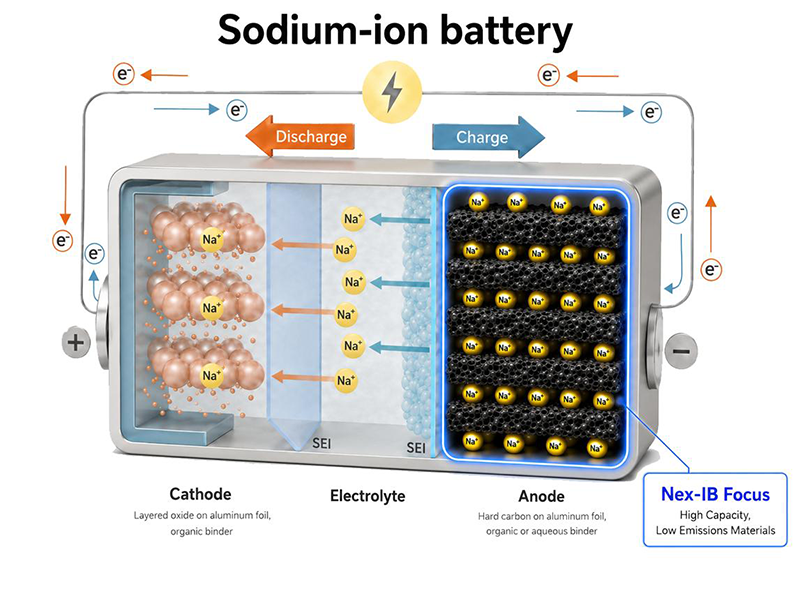
A sodium-ion battery (Na-ion battery) is a rechargeable battery that uses sodium ions as the charge carriers to store and release electrical energy.
Its working principle is similar to that of a lithium-ion battery. During charging and discharging, sodium ions move between the positive and negative electrodes through an electrolyte, generating and storing electrical energy.
The main difference lies in the materials used inside the battery. Instead of relying on lithium, sodium-ion batteries use sodium-based electrode materials. Sodium is widely available in nature and can be obtained from sources such as salt deposits and seawater.
Compared with lithium, sodium is much more abundant and geographically widespread. This creates opportunities for developing more diversified battery supply chains and reducing dependence on certain critical raw materials.
As battery technology continues to advance, sodium-ion batteries are gradually moving from laboratory research toward commercial applications, including energy storage systems, electric vehicles, industrial equipment, and automotive power solutions.
Sodium-ion batteries offer a different combination of performance, material availability, and application potential. Although no single battery technology is superior in every category, sodium-ion batteries have several promising advantages.
A. Compared with Traditional Lead-Acid Batteries
B. Compared with Lithium-Ion Batteries
C. A Comparison of Three Battery Technologies
|
Performance |
Lead-Acid |
Sodium-Ion |
Lithium-Ion |
|
Main raw materials |
Lead-based materials |
Sodium-based materials |
Lithium-based materials |
|
Low-temperature performance |
Limited |
Promising |
Chemistry-dependent |
|
Cycle life |
Generally shorter |
Competitive potential |
Generally competitive |
|
Raw material availability |
Established supply chain |
Abundant sodium resources |
Dependent on lithium supply
|
|
Commercial maturity |
Very mature |
Developing rapidly |
Highly mature |
The comparison above represents general technology characteristics rather than guaranteed performance for every product. Actual performance depends on battery chemistry, manufacturing processes, and application requirements.
For automotive starting applications, factors such as cold-cranking performance (CCA), starting current, charging compatibility, operating temperature, and reliability are particularly important.
The rapid growth of electric vehicles, renewable energy, and global energy storage demand is increasing the need for diversified battery technologies.
However, the lithium-ion battery industry also faces challenges, including raw material price fluctuations, supply chain concentration, and the need for improved performance under extreme operating conditions.
Developing sodium-ion batteries offers several important opportunities.
First, reducing dependence on lithium resources.
Sodium is widely available around the world. Developing sodium-ion technology can help diversify battery manufacturing resources and reduce reliance on a single battery chemistry.
Second, improving battery performance in extreme climates.
Temperature has a significant impact on battery performance. Sodium-ion batteries have demonstrated promising low-temperature characteristics, making them attractive for applications in cold regions and demanding operating environments.
Third, supporting sustainable energy development.
As solar and wind power installations continue to expand, large-scale energy storage becomes increasingly important. Sodium-ion batteries offer another potential solution for stationary energy storage and renewable energy integration.
Fourth, driving innovation in the automotive battery industry.
The automotive battery market has traditionally relied heavily on lead-acid and lithium-based technologies. The development of sodium-ion batteries introduces new possibilities for automotive starting power, auxiliary power, and other vehicle-related applications.
For battery manufacturers, continuous research and development in new battery chemistries is essential to remain competitive in an evolving global market.
Sodium-ion batteries are entering an important stage of commercialization. With continuous improvements in electrode materials, battery design, and manufacturing technology, their potential applications are expanding.
According to the International Energy Agency (IEA), sodium-ion batteries are moving into a scale-up phase, with growing interest from major battery manufacturers. Their promising low-temperature performance and diversified raw material supply chains are important drivers of future development.
Several market segments are expected to create opportunities for sodium-ion battery technology:
1. Automotive Batteries
Automotive starting batteries represent a potential application area for sodium-ion technology. As manufacturers continue to optimize starting power, charging compatibility, and operating reliability, sodium-ion batteries may provide an additional solution for passenger cars and commercial vehicles.
2. Electric Vehicles
Sodium-ion batteries are attracting attention in smaller electric vehicles, short-range transportation, and vehicles operating in cold climates, where low-temperature performance can be particularly valuable.
3. Energy Storage Systems
Large-scale energy storage is one of the most promising markets for sodium-ion batteries. Their resource availability and potential cost advantages make them attractive candidates for renewable energy storage and grid applications.
4. Industrial and Special-Purpose Equipment
Forklifts, industrial machinery, backup power systems, and other specialized equipment may also benefit from sodium-ion battery development, depending on their performance and application requirements.
Although sodium-ion batteries still face challenges in energy density, manufacturing scale, and cost competitiveness, continuous technological improvements are creating new commercial opportunities.
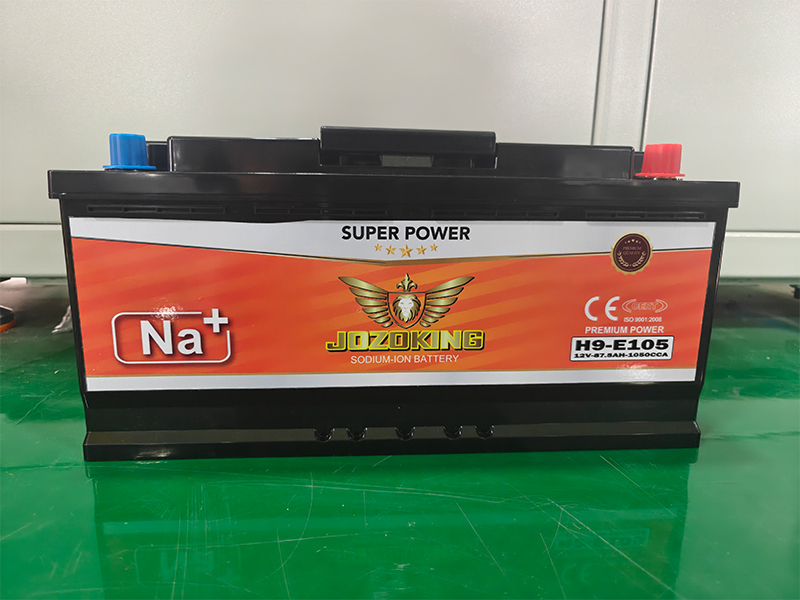
As a battery manufacturer committed to technological innovation, JOZOKING continues to explore new battery technologies and expand its product portfolio.
We are proud to announce that JOZOKING has successfully developed sodium-ion batteries and brought this technology into practical use.
The product showcased in this announcement is a 12V sodium-ion automotive starting battery, designed to bring sodium-ion technology into the automotive starting battery segment.
This achievement represents an important milestone in JOZOKING's ongoing battery research and development efforts. It also demonstrates our commitment to exploring next-generation battery solutions and responding to the changing needs of the global automotive market.
JOZOKING will continue investing in battery technology development, product optimization, and manufacturing innovation to provide customers worldwide with more diversified and reliable battery solutions.
JOZOKING – Exploring New Battery Technologies. Powering the Future.

Jozoking,Top global battery manufacturer. We provide you with automotive battery,lead acid battery deep cycle gel Agm battery, Lifepo4 and lithium battery.


Floor 3 Xuefu Building Xuefu Industrial Zone Jing Wu Town XiQing District TianJin China
Copyright © Jozoking (Tianjin) Technology Co, Ltd. All Rights Reserved | Privacy Policy | Blog


 EN
 AR
 BG
 HR
 CS
 DA
 NL
 FI
 FR
 DE
 EL
 IT
 JA
 KO
 NO
 PL
 PT
 RO
 RU
 ES
 SV
 TL
 ID
 SR
 SL
 VI
 SQ
 HU
 TH
 TR
 MS
 GA
 MK
 HY
 AZ
 BN
 MN
 MY
 KK
 UZ
 JOZO GROUP
